
Amit Kumar C Jain
Consultant and Head, Amit Jain’s Diabetic Foot and Wound Research Unit, Amit Jain’s Institute of Diabetic
Foot and Wound Care, Brindhavvan Areion Hospital, Bengaluru, Karnataka, India
Abstract
Introduction
It is projected that in the year 2045, there will be around 700 million people in the world living with diabetes
mellitus [1]. One of the most challenging problems of diabetes mellitus is the diabetic foot ulcer [2]. In fact, the
diabetic foot problems today are one of the leading causes of disability that results in financial burden in
healthcare system [3].
It is known that diabetic foot ulcer results in almost 85% of non-traumatic lower limb amputation [4]. The global
prevalence of ulcers in diabetic foot is around 6.3% and recurrence of foot ulcer is reported to be very high [2].
Offloading of diabetic foot ulcers is one of the most important treatment modality in management of these ulcers
[5]. There are numerous offloading methods that are available for healing the diabetic foot ulcers [6]. The
offloading could be external/mechanical (non-surgical) or surgical offloading [7].
Amit Jain’s ‘SCC classification’ is a new classification that was developed first for diabetic foot ulcer and later it
was extended and applied to Charcot foot, foot amputations, therapeutic footwear, callus, etc [8, 9]. All these
concepts belong to Amit Jain’s principle and practice of diabetic foot [10].
Amit Jain’s Classification for Surgical Offloading
The primary author proposes a new classification for surgical offloading, which is an expansion and extension of
his “SCC” classification in diabetic foot [9].
According to this new classification, surgical offloading can also be divided into 3 general classes (Table 1)
namely simple, complex and complicated surgical offloading. It can also be applied to non-diabetics.
The classification is based not just on expertise of performance of the procedure but also understanding the
pathology, mechanobiology/biomechanics and application of the procedure/case selection.
This is a simple, easy to remember, practical, descriptive, open classification wherein any new surgical
offloading developed in future can be placed in any one of the classes.
| Class of surgical offloading | Description | Examples |
|---|---|---|
| Class 1 surgical offloading | Simple | Tenotomies, Tendoachillies lengthening, Gastronemius recession, etc |
| Class 2 surgical offloading | Complex | Osteotomies, Arthroplasty, Resection, etc |
| Class 3 surgical offloading | Complicated | Tendon transfers |
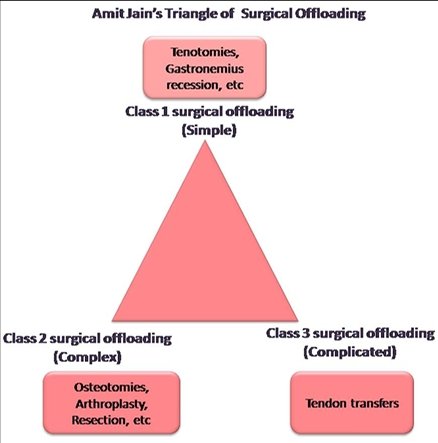
Further, we can have triangle of surgical offloading in pattern similar to triangle of amputation and triangle of
offloading (non –surgical) wherein the 3 available options can be placed at the 3 corners of the triangle [10, 11].
This can also serve as a good teaching tool (Figure 1).
Conclusion
References
1. Jodheea-Jutton A, Hindocha S, Luximon AB. Health economics of diabetic foot ulcer and recent trends to
accelerate treatment. The Foot, 2022, 101909.
2. Dogruel H, Aydemir M, Balci MK. Management of diabetic fot ulcers and the challenging points: An
endocrine view. World J Diabetes,2022:13(1):27-36.
3. Francia P, Gualdani E, Policardio L et al. Mortality risk associated with diabetic foot complications in
people with or without history of diabetic foot hospitalizations. J Clin Med,2022:11:2454.
4. Shah P, Inturi R, Anne D et al. Wagner’s classification as a tool for treating diabetic foot ulcers: Our
observations at a suburban teaching hospital. Cureus,2022:14(1):e21501.
5. Chadwik P, Astley E, Dunn G et al. Recommendations for improving offloading for the foot in diabetes.
The Diabetic Foot Journal,2022:25(1):1-8.
6. Jain AKC, Apoorva HC. Looking at offloading in diabetic foot from a different angle- the triangle.
Medicine Science,2021:10(4):1562-5
7. Amr W, Far HMA, Abady OMA, Yassin MA. Comparison between surgical offloading and mechanical
offloading in treatment of plantar diabetic foot ulcer. The Egypt J Hosp Med,2022:87:1303-1306.
8. Jain AKC. A new classification for diabetic foot surgery. Int J Surg & Surgical Res,2020:2:6-8.
9. Jain AKC. Extended application of Amit Jain’s ‘SCC’ classification concept for diabetic foot. Int J Surg
Sci,2019:3:188-91.
10. Jain AKC. Supermodern diabetic foot surgery. Medicine Science,2021:10(3):1081-4.
11. Jain AKC. Amit Jain’s Destructive/Amputation Ladder and its Variants. Saudi J Med,2020:5:214-21.